The MCP platform that engineering leaders trust
Deployed in your private cloud, behind your firewall
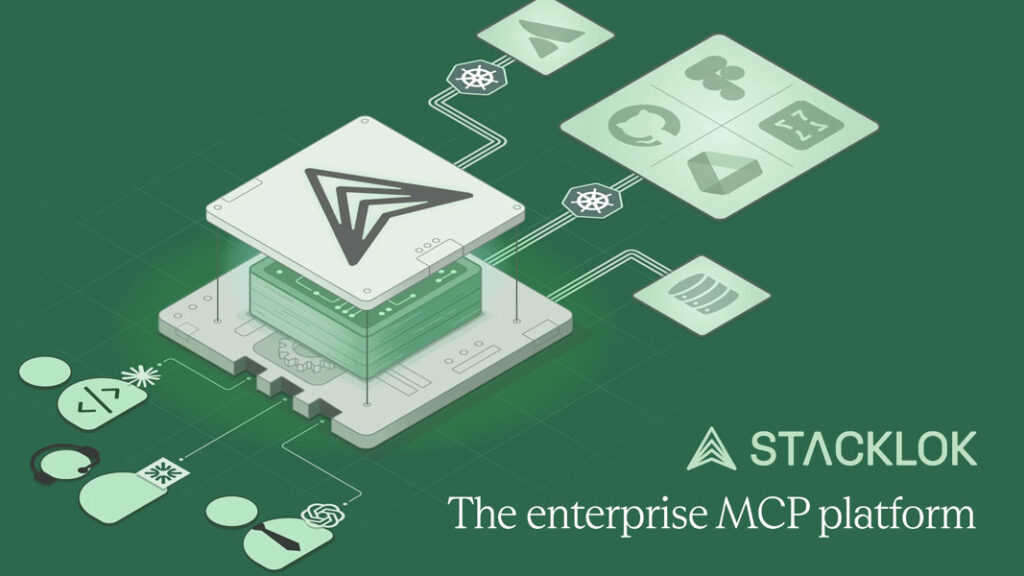
You’ve been charged with leading your enterprise’s MCP journey
We can help you deliver a platform that is …

Local
Avoid SaaS solutions, and safeguard your data with an MCP platform that runs in your private cloud and meets your regulatory requirements

Modular
Rapidly implement an end-to-end MCP platform or grab only the components you need to complement your internal efforts

Scalable
Start with developers, but scale to all knowledge workers with centralized admin and a clean end user experience

Open Source
Work with an open source leader to de-risk your investments and ensure a path to long-term sustainability
A complete MCP platform
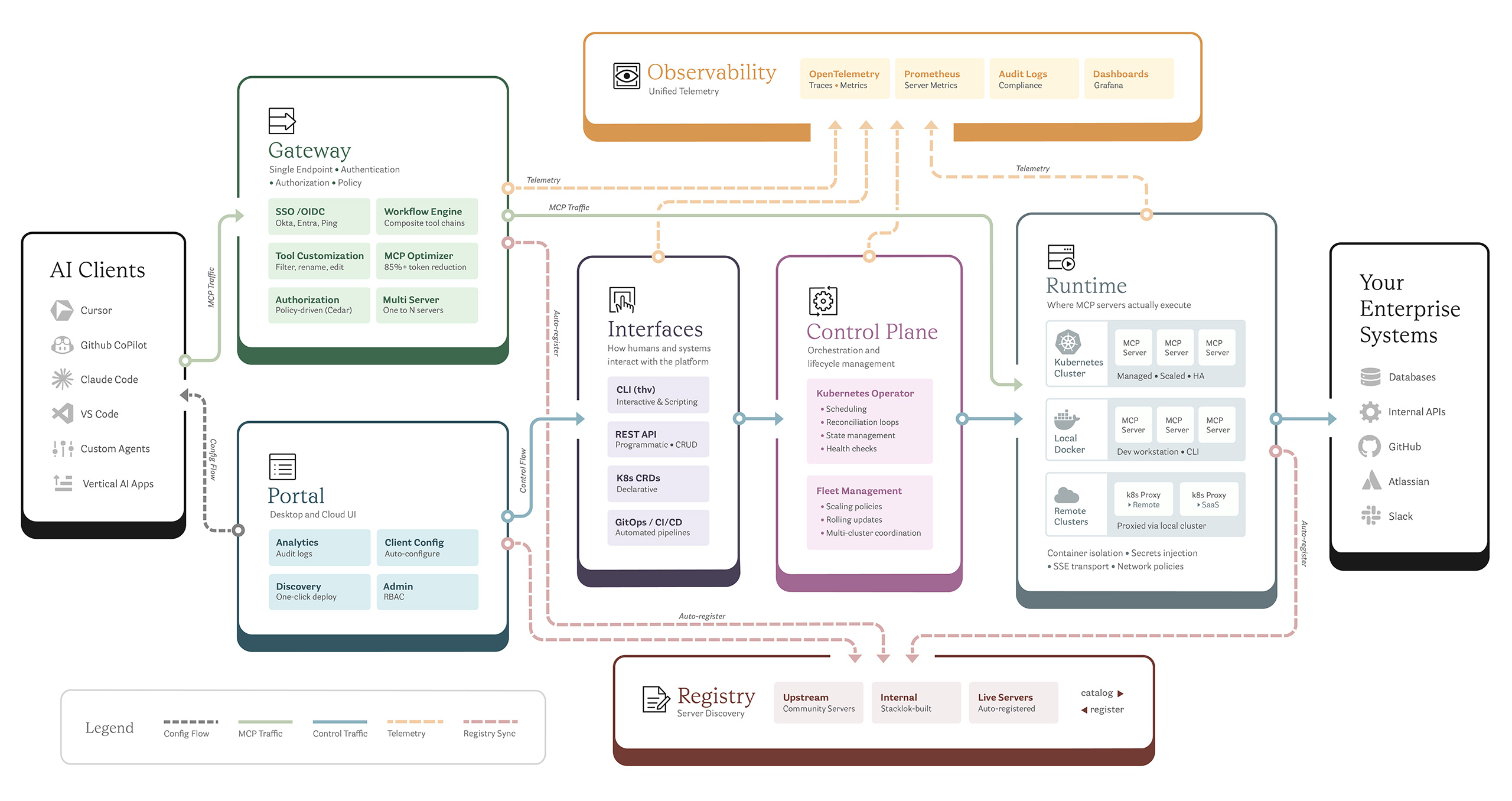
Stacklok’s team are co-creators of Kubernetes, Sigstore and more. We know how to build production-ready platforms, and our MCP platform includes security at every layer
Gateway
Define dedicated endpoints from which your teams can securely and efficiently access tools.
- Centralized security, authentication, and auditing
- IdP integration for SSO (OIDC/OAuth)
- Orchestrate tools into a single virtual MCP
Registry
Curate a catalog of trusted servers your teams can quickly discover and deploy.
- Verify provenance with built-in security controls
- API management for seamless governance
- Preset configurations for easy onboarding
Runtime
Deploy, run, and manage MCP servers locally or in a Kubernetes cluster with security guardrails.
- Deploy via Kubernetes for enterprise scale
- Kubernetes Operator for fleet management
- OpenTelemetry and Prometheus for monitoring
Portal
Simplify MCP adoption for developers and knowledge workers across your enterprise
- Desktop app and browser-based cloud UI
- Easy admin curation of servers and tools
- Compatible with hundreds of AI clients
Architected for Enterprises
We’ve designed the Stacklok Enterprise MCP Platform to integrate with your Kubernetes footprint, run in your environment and fit seamlessly into your existing workflows.
We deliver immediate outcomes
Stacklok’s Enterprise MCP Platform is being used in production by Fortune 500 companies that need measurable results.
Curate a custom registry
Eliminate shadow AI. Ensure every MCP server meets your quality and compliance standards and that employees never bring their own MCP servers to work
Centralize control of local and remote MCP servers
Keep sensitive workloads local and provide frictionless access to remote servers all from the same central registry and intuitive UI.
Build a gateway to your spec
Avoid off-the-shelf MCP Gateways that can’t meet your compliance requirements. Build your gateway to your specifications with flexible tech and expert support
Building in the open and with the community
Stacklok’s platform is a hardened distribution of our popular ToolHive open source project
ToolHive is Apache 2.0 licensed and we intend to donate the project to an open source foundation
ToolHive includes external maintainers from Red Hat and contributors from dozens of companies
ToolHive has a growing community of users and we encourage you to get involved
Get started with Stacklok
for Enterprise
Start by curating a registry of trusted MCP servers for your enterprise
for Individuals
Dive into the ToolHive repo and docs, and then engage directly with our team.
Frequently asked questions
Two primary reasons to consider an MCP platform are (1) Security. Where the MCP spec stops at front-end authentication, an MCP platform also addresses back-end authentication, authorization, network isolation, token exchanges and other advanced features. (2) Usability. Direct use of MCP servers puts users in charge of MCP server discovery, installation and configuration, whereas an MCP platform allows admins to permission and pre-configure MCP servers so that end users can access context with a single command or click.
Stacklok supports VS Code with GitHub Copilot (v1.99.0+), Cursor, Roo Code, Cline, and Claude Code with automatic configuration. Other clients and agent libraries that support Server-Sent Events (SSE) can be used with manual configuration.
The Stacklok Enterprise MCP Platform provides secure secret management through encrypted storage or 1Password integration. Instead of storing API tokens in plaintext config files, you can securely store them in Stacklok’s encrypted vault and reference them when running servers. The encryption password is stored in your OS keyring for added security.
Yes! You can run custom servers using Docker images or directly from package managers. Stacklok supports Python packages via uv, Node.js packages via npm, and Go packages via the Go toolchain. When you specify a package, Stacklok automatically builds a Docker image and runs it securely.
Stacklok runs MCP servers in isolated containers with minimal permissions by default. It uses an SSE proxy to forward requests without exposing container ports directly to the network. You can customize permissions using JSON profiles to grant only the specific network access or file system permissions based on your server’s needs. Whereas the MCP spec addresses front-end authentication (of user to server), Stacklok also offers back-end authentication (of server to resource), authorization, token exchange and numerous other advanced security features.
Stacklok provides an interface to view all running servers, stop or remove them as needed, and search for new servers to deploy. You can get detailed information about any server in the built-in registry, including its available tools and configuration options. For support, check the GitHub repository or join the community Discord channel.